

The Silent Thief: My Battle With Empty Bank Accounts and Sleepless Nights
I still remember the exact moment my stomach completely dropped. It was a Tuesday morning, exactly two months into my brand-new business venture. I opened my banking app on my phone, expecting to see enough money to cover my next round of software subscriptions.
Instead, I stared at a number so low it made my hands physically shake. I had practically nothing left. My grand dreams of becoming a successful business owner were suddenly replaced by a heavy, crushing panic in my chest.
I thought I had planned everything perfectly. I had a great product idea, a beautiful website, and a handful of interested clients. But I completely underestimated how quickly hidden expenses would eat through my savings.
I started having constant sleepless nights. I would lie awake at 3 AM, staring at the ceiling, mentally calculating how I was going to pay my internet bill. Every single time my phone buzzed with an email notification, my heart raced, thinking it was another unexpected invoice.
This financial anxiety did not just hurt my business; it bled into my everyday life. I stopped going out with friends because I was terrified of spending even a few extra dollars on coffee. I was irritable, constantly exhausted, and completely disconnected from the people I loved most.
The mental toll was easily the hardest part. You start to question your own self-worth. You wonder if leaving your comfortable job was the biggest mistake of your entire life. You feel entirely alone because everyone else on social media seems to be succeeding while you are secretly drowning in money worries.
Building Your Financial Armor: A Practical Blueprint for Survival
This problem happens to almost every new business owner. The good news is that you can entirely change your financial situation by taking specific, measured actions today. Let us look at a few highly practical ways to protect your hard-earned money and buy yourself peace of mind.
The Three-Month Oxygen Tank Strategy
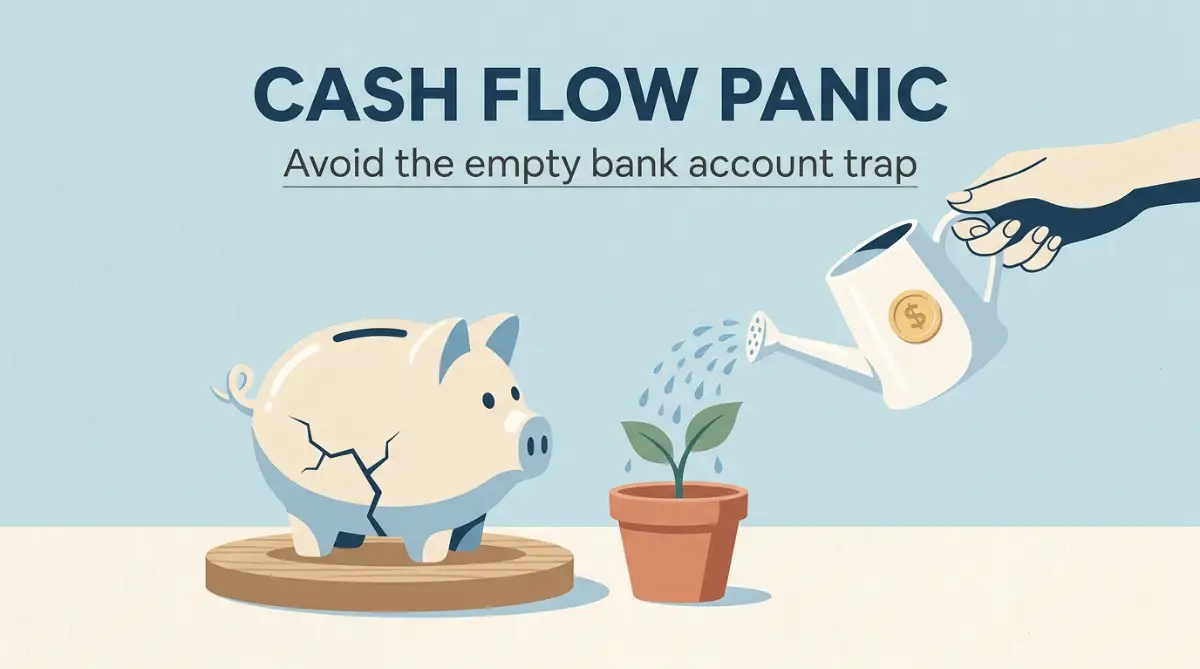
Think of your business like a scuba diver exploring a deep reef. If you dive in without enough oxygen in your tank, you are going to panic and make terrible decisions. In the business world, your cash reserve is your oxygen tank.
Most new entrepreneurs make the mistake of reinvesting every single penny back into the business immediately. This leaves them completely exposed to random problems. If a client refuses to pay on time, or your laptop suddenly breaks down, you have no safety net.
You need to build a dedicated emergency fund specifically for your business operations. I call this the "Oxygen Tank Strategy." The goal is to save enough cash to run your business for at least 90 days, even if you make zero sales during that time.
How to calculate your exact number:
Start by writing down only your absolute bare-minimum survival expenses. Do not include fancy marketing tools or expensive office chairs. Calculate the exact cost of your domain hosting, essential software, basic inventory, and minimum living expenses if you rely on the business to eat.
Multiply that bare-minimum number by three. That final number is your initial safety target. Put this money into a completely separate savings account that you cannot easily access from your phone.
Real-life example:
Imagine your minimum business expenses are $500 a month. Your oxygen tank goal is $1500. It might seem like a lot right now, but having that $1500 sitting safely in a different bank account changes your brain chemistry. You stop acting out of desperation and start making calm, logical business decisions.
Pro Tip: My "Wait 48 Hours" Rule
I used to be terrible with impulse buying online. Whenever I saw a shiny new marketing tool that promised to double my sales, I would immediately buy it. Now, I use the "48-Hour Rule." If I see a tool or course I want for my business, I write it down on a sticky note and wait two full days. Usually, after 48 hours, the excitement fades away, and I realize I do not actually need it at all. This simple habit alone has saved me thousands of dollars.
Mastering the Art of Lean Operations
When you first start, you do not need the best of everything. You just need things to work. This is the core idea behind lean operations.
Many beginners try to look much bigger than they actually are. They rent expensive co-working spaces, buy custom branded boxes, and hire expensive branding agencies before they even have their first five customers. This is a massive trap.
Your only focus right now should be validating your product and keeping your costs as close to zero as possible. If you can work from your kitchen table instead of renting an office, do it. If you can use free versions of software instead of paid plans, do it immediately.
Let us look at a simple comparison of how quickly expenses can drain your accounts if you are not careful.
As you can clearly see, making slightly different choices in the beginning can save you hundreds of dollars every single month. That saved money is your direct ticket to long-term survival.
Setting Unbreakable Payment Boundaries
One of the biggest financial risks you will face is late-paying clients. You might deliver an amazing service on time, but if the client takes 60 days to pay the invoice, you are the one left holding the bag.
You must stop acting like a bank for your customers. A bank gives out loans and waits for people to pay them back. You are running a small business, not a bank.
To protect yourself, you must set extremely clear payment boundaries from day one. Never start a large project without asking for an upfront deposit.
The 50/50 Approach:
For any service-based work, ask for 50 percent of the total cost before you even open your laptop to start working. The remaining 50 percent is due immediately upon delivery. If a potential client argues against a deposit, they are showing you a massive red flag.
Good, respectful clients expect to pay deposits. It shows them that you are a professional who values your own time. This single boundary ensures that your cash flow keeps moving, even if the final payment is slightly delayed.
Do not let fear dictate your business rules. It is better to lose a bad client who refuses to pay a deposit than to do a month of hard work and never get paid at all.
The Immediate Money Split Technique
Mixing personal money and business money is a nightmare waiting to happen. It is easily the most common mistake new founders make.
When your personal groceries and your business software payments are coming out of the exact same checking account, you lose all visibility. You have no idea if your business is actually making a profit or if it is secretly draining your personal savings.
You must draw a hard line in the sand today. You need separate accounts, even if you are just a one-person show right now.
Go to your local bank or use an online banking app to open a dedicated business checking account. All of your income from customers must go directly into this account. All of your business expenses must be paid from this account.
If you need money for personal groceries or rent, you manually transfer a specific amount from your business account to your personal account. Think of it as paying yourself a small, controlled salary.
This clear separation makes tax time significantly easier. More importantly, it forces you to look at your business as a standalone machine. If the business account is empty, you cannot just blindly swipe your personal debit card to cover a business expense without feeling the pain of that choice.
Myth vs. Reality in Early Business Finance
Let us clear up some common misunderstandings that cause massive financial stress for new owners.
Myth: You have to spend money to make money.
Reality: You have to spend money wisely to make money. Throwing cash at random Facebook ads without a plan is just burning your savings. Time, creativity, and hustle are often better investments than money in the beginning.
Myth: I will worry about tracking my money once I am actually making a lot of it.
Reality: If you cannot manage $100 properly, you will completely ruin a $10,000 month. Good financial habits start when the bank account is low. Tracking your small expenses builds the muscle you need for managing big profits later.
Implementing the Weekly Money Date
Financial anxiety grows in the da