

The Heavy Burden of Educational Doubt
I still remember sitting in my tiny bedroom, staring at my laptop screen with an incredibly heavy heart. My acceptance letter for a popular online university program was right in front of me, yet I felt completely paralyzed by doubt.
Everyone around me kept saying that virtual learning was just a massive scam. They warned me that hiring managers would simply laugh at my resume and toss it straight into the trash.
I spent endless sleepless nights worrying if I was making a terrible mistake that would ruin my entire professional life. The constant judgment from friends and older relatives destroyed my mental peace.
Every time I tried to feel excited about my future, someone would make a sarcastic comment about my "fake internet school." It felt like I was fighting a lonely battle just to get an education.
You might be feeling that same heavy burden right now. The fear of being judged as an "unqualified" graduate keeps so many talented, hard-working people away from their biggest dreams.
We hear these terrifying rumors everywhere, and suddenly, pursuing a flexible education feels like walking directly into a dangerous trap. The anxiety of spending your hard-earned money on something people disrespect is incredibly overwhelming.
But let me tell you, letting these baseless rumors control your life choices is the real tragedy. You deserve to know the actual truth before you give up on a path that could completely change your life.
Shattering The Illusions: The Truth About Virtual Education
When you hear a lie enough times, your brain naturally starts to accept it as a hard fact. This psychological trick is exactly why so many brilliant students avoid digital classrooms today.
Let us break down these false stories using logic, actual industry trends, and plain common sense. It is time to clear the smoke and look at the reality of modern education.
The Big Lie About Employer Rejection
The most terrifying story you will hear is that companies hate remote graduates. People will aggressively tell you that a digital diploma holds zero weight in the real job market.
Think about this logically for a second. We currently live in a world where massive global companies operate entirely through remote work and digital communication.
Why would a modern company, which conducts its own business over video calls, instantly reject a candidate who learned through those exact same digital methods? It simply makes no sense.
Employers are actually looking for specific skills, not a physical location. They want problem solvers, self-starters, and people who know how to manage their own time effectively.
When you complete a rigorous program from your own home, you are silently proving that you possess intense self-discipline. You are showing hiring managers that you do not need a babysitter to get your work done.
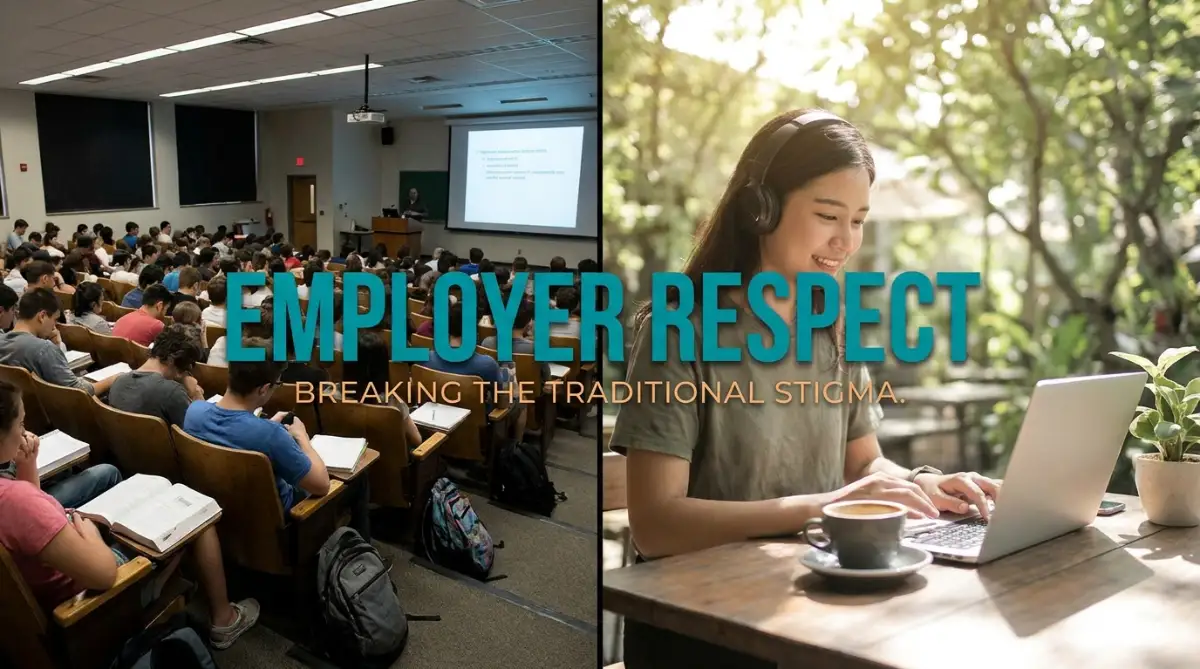
The Illusion of "Easy" Academics
Another extremely popular rumor is that logging into a class from your couch means the work is automatically easier. Many traditional students love to joke that remote learners are basically buying their grades.
This could not be further from the actual truth. In fact, learning from home often requires significantly more mental effort than sitting in a physical lecture hall.
When you sit in a regular classroom, the teacher actively forces you to pay attention. If you are learning remotely, you must become your own absolute boss and motivator.
Traditional vs Remote Learning Expectations
Looking at this breakdown, you can see that remote students carry a massive amount of personal responsibility. You have to read dense materials, complete complex assignments, and meet strict deadlines entirely on your own.
There is no one standing over your shoulder reminding you to study for your midterm exam. The academic rigor is the same, but the required personal discipline is actually much higher.
The Loneliness Myth: Networking in a Digital World
People love to claim that you will never make any real friends or professional connections if you do not set foot on a physical campus. They imagine remote students sitting alone in a dark room, completely isolated from human contact.
The reality of digital networking is completely different and often much more powerful. You are no longer restricted to meeting people who just happen to live in your specific city or dorm building.
In a digital classroom, your group project partner might be a marketing manager in London, while your peer reviewer is a software engineer in Tokyo. You are instantly exposed to a global network of ambitious professionals.
I used to think I was totally alone in my studies, until I started sending direct messages to my classmates on LinkedIn. My biggest mistake was staying silent, but once I reached out, I built a stronger network than I ever did in a physical classroom.
You have access to virtual study groups, active alumni Slack channels, and digital discussion boards. If you know how to type a friendly message, you can build an empire of professional contacts without ever leaving your desk.
Demystifying Accreditation and Support Systems
There is a deep-seated fear that virtual programs are completely unregulated "diploma mills" running wild on the internet. People assume that you are just paying money to a random website that prints fake papers.
This assumption ignores the entire existence of regional and national educational boards. Proper online universities go through the exact same intense auditing processes as historic brick-and-mortar colleges.
The Invisible Shield of Accreditation
When you pick a properly accredited program, you are protected by a strict standard of quality. The government and independent educational bodies heavily monitor these institutions to ensure they teach real, valuable material.
Your degree will not say "Online Graduate" in big red letters across the top of the paper. It will simply state the name of the institution and the field you mastered.
Always check the official accreditation status of any program before you spend a single penny. If the school holds proper credentials, the credits you earn are completely legitimate and legally recognized.
The Truth About Professor Availability
"Your teachers will ignore you" is another lie that keeps students awake at night. People imagine sending an email into a black hole and never getting a response from their instructors.
In a massive traditional university, you are often one of five hundred students sitting in a gigantic auditorium. The professor probably does not even know your name, let alone your personal learning style.
In a well-designed remote program, professors hold dedicated virtual office hours where you can speak to them one-on-one through video calls. They give highly detailed, written feedback on your assignments because digital tracking requires a paper trail.
Many remote instructors are actual industry professionals who work in the field during the day and teach at night. This means they are giving you fresh, real-world advice instead of reading from a twenty-year-old textbook.
Overcoming The Fear of Missing Out (FOMO)
We need to address the emotional side of choosing a flexible educational path. Society has conditioned us to believe that the "college experience" must involve football games, massive parties, and living in tiny dorm rooms.
When you choose a digital path, you might experience a sense of grief for the traditional college life you see in movies. Your friends might post pictures of their campus events, and you might feel a sharp sting of jealousy.
Redefining Your Personal Success Story
It is incredibly important to remember why you chose this path in the first place. Are you trying to win a popularity contest, or are you trying to build a stable, profitable future for yourself?