

The Silent Weight of Building a Dream from Absolute Scratch
I still remember sitting on my cold living room floor at 3 AM, staring blankly at a blinking cursor on my laptop. My bank account was dangerously low, my self-doubt was at an all-time high, and I had absolutely no idea if my tech venture would survive another month. I felt like I was drowning in a glass of water, desperately trying to keep a brave face for my family while my chest felt incredibly tight with anxiety. Every time my phone buzzed, my heart would race, expecting another server crash or a canceled subscription. I was completely exhausted, yet my brain refused to shut down, trapping me in an endless loop of "what-if" scenarios. It was my darkest moment, and I realized that building a business from scratch costs way more than just money—it takes a massive piece of your soul.
When we talk about launching a tech company without outside funding, we usually hear amazing stories of massive success. People love to share screenshots of high revenue and celebrate the freedom of being their own boss. But behind closed doors, the reality for everyday people trying to make this work is entirely different.
The everyday struggle quietly eats away at your mental peace. You wake up feeling behind schedule before you even step out of bed. Your personal relationships start to suffer because you are physically present at the dinner table but mentally completely checked out.
You find yourself snapping at the people you love over tiny things. Friends stop inviting you to events because your answer is always, "I have to work." Slowly, your entire identity becomes tied to your business performance.
When the business has a good day, you feel like a king. But when a bug breaks your software or a customer demands a refund, you feel like a total failure. This emotional rollercoaster is exhausting, and the worst part is that you feel completely alone.
You cannot complain to your employees because you need to look strong as a leader. You cannot complain to your family because you do not want to scare them about your financial situation. You carry this massive, invisible backpack of stress every single day, and nobody warns you just how heavy it gets.
Escaping the Founder's Trap: Reclaiming Your Sanity and Focus
The first thing you need to accept is that feeling overwhelmed does not mean you are a bad entrepreneur. It simply means you are a human being trying to do the job of an entire corporate department all by yourself.
When you bootstrap a venture, you are the CEO, the marketing team, the customer support agent, and the janitor. The constant context-switching fries your brain's dopamine receptors. Let us break down how you can actually survive this journey without losing your mind.
The Myth of the "Sleepless Hustler" vs. The Reality of Human Biology
We have been brainwashed by internet gurus into believing that sleeping four hours a night is a badge of honor. I am here to tell you that this mindset is a direct ticket to a hospital bed.
Scientifically speaking, when you constantly deprive yourself of rest, your body increases the production of cortisol, the primary stress hormone. High cortisol levels destroy your ability to make logical decisions.
You start reacting to problems instead of solving them. A simple customer complaint suddenly feels like a personal attack. To stop this toxic cycle, you must treat your sleep schedule as the most important business meeting of your day.
Here is a quick look at how the hustle myth compares to sustainable reality:
If you ignore your biological limits, your business will eventually crash because its core engine—you—has completely burned out.
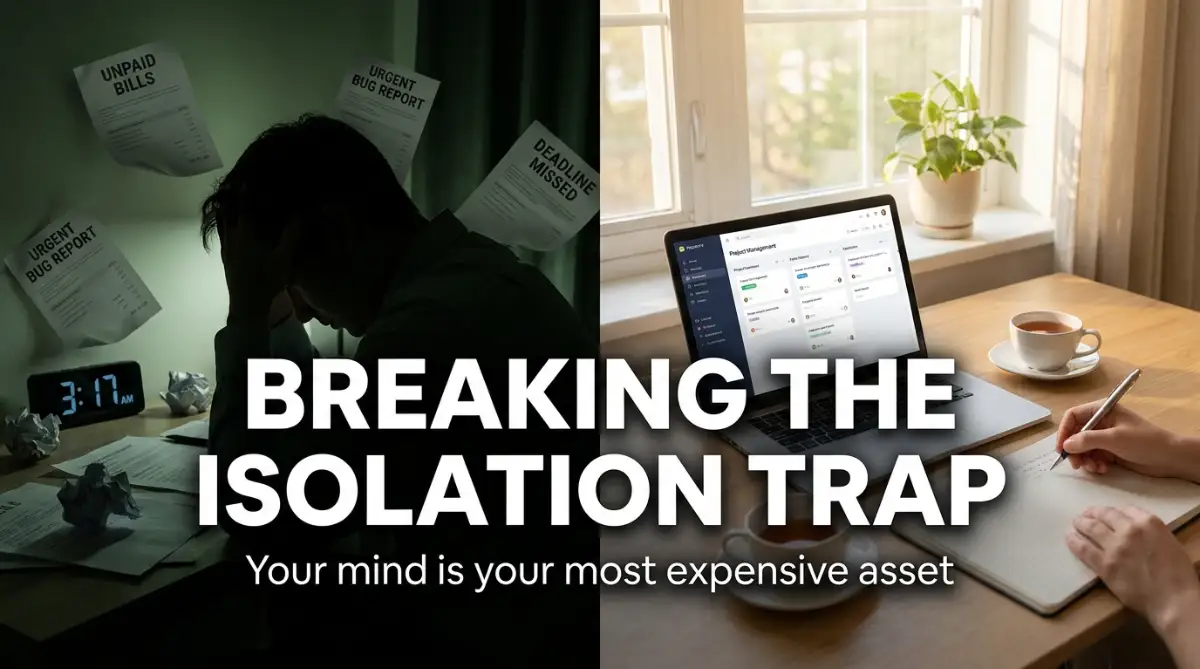
Severing the Link Between Net Worth and Self-Worth
This is perhaps the hardest lesson to learn when building a software product from the ground up. Because you created this tool with your own hands, you naturally feel like its success defines your value as a person.
If a marketing campaign fails, you tell yourself, "I am a failure." This cognitive distortion will destroy your confidence completely. You have to actively build a mental firewall between who you are and what you sell.
Pro Tip: I used to tie my self-worth entirely to my Monthly Recurring Revenue. It destroyed my confidence and made me incredibly bitter. My biggest realization was that my business is just an experiment I am running, not a reflection of my human value; detaching these two things finally allowed me to sleep properly at night.
To separate your identity from your startup, start investing time in hobbies that have zero connection to screens or business. Whether it is gardening, cooking, or playing a musical instrument, you need an activity where you are allowed to be completely terrible at it without any financial consequences.
Building an Emotional Support Infrastructure
You cannot survive the tech startup game in total isolation. Many founders try to act like lone wolves, but human beings are biologically wired for community support.
When you sit alone in your room coding and planning all day, you lose perspective. A minor bug can look like the end of the world simply because you have no one around to tell you, "Hey, this is normal, we can fix it."
Find a group of people who are exactly on the same journey as you. Do not just talk to highly successful billionaires on the internet; find peers who are currently in the mud with you.
Sharing your weekly failures with someone who truly understands the pain of a rejected payment or a failed launch is incredibly healing. It normalizes your struggle.
The Art of Financial Padding for Mental Clarity
Financial anxiety is the root cause of almost all emotional distress in bootstrapping. When you do not know how you will pay rent next month, your brain goes into "survival mode."
In survival mode, you cannot think creatively. You cannot design a beautiful user interface or write engaging marketing copy when you are terrified of starving.
This is why quitting your day job too early is often the biggest mistake you can make. Having a boring, stable income source while you build your tech venture on the side is not a sign of weakness. It is a massive strategic advantage.
A stable paycheck acts as an emotional shock absorber. It allows you to make business decisions based on long-term growth rather than short-term desperation.
If a client demands unreasonable changes, you can comfortably say "no" because you are not relying on their money to buy groceries. This power to say "no" is the ultimate freedom in business.
Micro-Resting: The Secret Weapon for Solo Founders
When you are bootstrapping, taking a two-week vacation to a tropical island is usually impossible. But that does not mean you cannot rest. You just need to change how you define resting.
Introduce "micro-rests" into your daily routine. A micro-rest is a 15-minute period where you completely step away from all business inputs.
Do not check your email. Do not look at your code. Do not listen to a business podcast.
Just step outside, look at the sky, and let your brain process the massive amount of information it has consumed. These tiny pockets of silence prevent the daily buildup of mental pressure.
Try the 90/20 Rule for Better Energy Management
Your brain works in natural energy cycles. Instead of forcing yourself to stare at a monitor for eight hours straight, work in intense 90-minute sprints.
After 90 minutes, your glucose levels drop, and your focus naturally scatters. Force yourself to walk away for 20 minutes. Drink some water, stretch your legs, or simply close your eyes.
You might think you are losing 20 minutes of productive time, but you are actually sharpening your mind for the next sprint. Working harder is not the goal; working sharper is.
Reframing Failure as Expensive Data Collection
The emotional toll hits the hardest when something you worked on for months completely flops. Maybe nobody signed up for your new feature, or your carefully crafted email sequence got zero replies.
Our natural reaction is shame and intense frustration. We feel like we wasted precious time and money that we honestly did not have to spare.
To survive this, you must change your internal vocabulary. Stop using the word "failure." Start calling it "data collection."
When a big tech company tests a feature, and it flops, they do not cry about it. They look at the analytics, learn exactly what the users do not want, and move on.
You must adopt this same analytical mindset. You did not waste three months; you just paid for an expensive, highly accurate lesson about your target market.
Every time you launch something that does not work, you are crossing off a wrong path on your map. This naturally brings you one step closer to the right path.
When you view your entire bootstrapping journey as a massive science experiment, the emotional sting of a setback disappears. You stop asking, "Why did this happen to me?" and start asking, "What is the data telling me to do next?"