
My Humiliating First Encounter With Decentralized Money
I still remember the knot in my stomach when I first tried to understand where my digital money actually lived. A friend had convinced me to buy a tiny fraction of a popular coin, and I stared blindly at my screen, sweating bullets. I kept searching for a customer service number or a bank branch name, feeling completely lost in a sea of tech jargon. Every article I read felt like it was written in an alien language designed to make me feel stupid. I realized I was putting my hard-earned savings into a system I could not even picture in my head. My brain just could not accept that money could exist without a central vault holding it securely. That feeling of helpless confusion is exactly why I decided to strip away the complex math and figure out what was really happening behind the screen.
If you are reading this right now, I know exactly how you feel. You hear incredibly smart people on podcasts talking about "decentralization" and "cryptographic hashes," and you just want to pull your hair out. It feels like an exclusive club where everyone else knows a secret language that you missed out on.
This knowledge gap is actually causing real emotional distress for ordinary people today. When you do not understand how something works, you naturally fear it, and that fear often leads to terrible financial decisions. You might be ignoring a massive technological shift simply because the explanation sounds too intimidating. Or worse, you might be blindly trusting random influencers with your money because you cannot verify the facts yourself.
The anxiety of feeling left behind is exhausting. You watch the news and see constant debates about the future of digital finance, and your mental peace is destroyed by the fear of missing out. People are losing sleep trying to figure out if they should jump in or stay far away.
The truth is, you do not need an advanced computer science degree to understand this concept. You just need someone to explain it using examples from your everyday life.
Breaking Down The Invisible Digital Notebook
We are going to completely change the way you look at digital trust. Instead of looking at confusing lines of code, we will look at this technology through the lens of ordinary human interactions.
Before we dive into the mechanics, let us clear up the biggest misconception that holds most people back.
Myth vs Reality: The Foundation Of Trust
The Popular Myth: Most people believe that this technology is just a fancy type of invisible coin that criminals use on the internet.
The Everyday Reality: The technology itself is simply a new way to store information transparently. Think of it as an indestructible public notebook that everyone in the world can read, but absolutely nobody can erase.
To truly grasp this, we need to look at how we currently trust strangers. Right now, if I want to send you a hundred dollars, we both have to trust a bank. I tell the bank to subtract the money from my account, and they tell your bank to add it to yours.
The entire global economy relies on these giant middlemen to keep accurate records. But what happens if the middleman makes a mistake, freezes your account, or gets hacked? You are completely at their mercy.
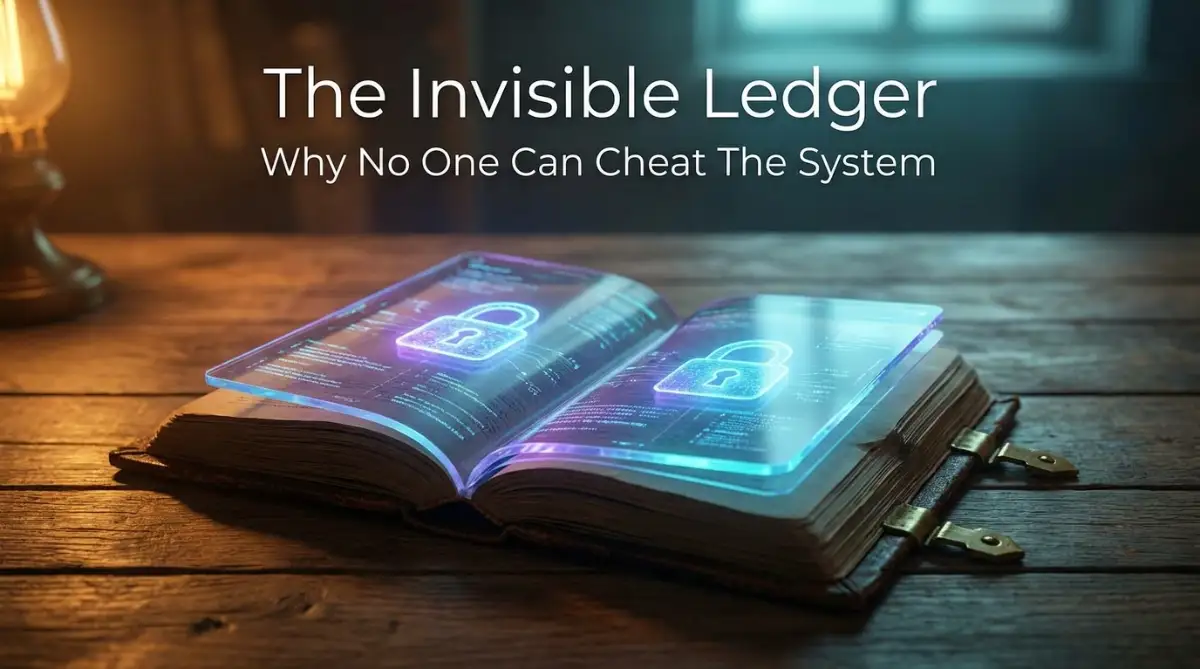
The "Shared Glass Library" Analogy
Imagine a giant public library made entirely of glass walls. Inside this library, there is a massive notebook resting on a pedestal in the center of the room. Every time someone wants to make a transaction, they announce it loudly to everyone standing in the glass library.
"I am giving five digital tokens to Sarah!" someone shouts. Everyone in the room immediately writes that exact statement down in their own personal copy of the notebook.
Because everyone wrote it down at the exact same time, there is a perfect, shared record of the event. If a dishonest person tries to cross out that line and rewrite it to say they have more money, it will not work. The rest of the people in the library will simply look at their own notebooks, realize the dishonest person is lying, and ignore them.
This is exactly what a decentralized network is. There is no single boss, no single bank, and no single point of failure. It is just thousands of computers around the world acting like the people in that glass library, constantly keeping exact copies of the same records.
How The Digital Blocks Actually Lock Together
Now that we understand the shared notebook, let us look at how the pages are protected. In this digital system, every "page" of the notebook is called a block.
When a page is completely filled with new transactions, it needs to be permanently sealed before a new page can be started. To seal it, the system creates a highly unique mathematical puzzle that acts like an unbreakable digital wax seal.
Once this block is sealed, it is officially attached to the previous page using a special digital fingerprint. This connection is the "chain."
If someone tries to go back and change a transaction on an older page, they would have to break the digital seal. Doing this would instantly change the fingerprint of that page.
Because all the pages are linked together, changing one fingerprint breaks the connection to every single page that comes after it. The thousands of computers watching the network would instantly see the broken chain and reject the change. This creates an environment of absolute, mathematically guaranteed security.
My biggest mistake early on was trying to understand the deep mathematical formulas behind cryptography. I quickly realized that you do not need to know how the engine of a car works to drive it to the grocery store. Just focus on understanding the core concept of a shared public notebook, and the rest of the pieces will naturally fall into place.
Bypassing The Traditional Gatekeepers
Let us look at a direct comparison to understand why this shift is so revolutionary for ordinary people. We are used to living in a centralized world, but the decentralized approach changes all the rules.
Smart Contracts: The Vending Machines Of The Internet
Once you understand the indestructible notebook, you can start doing some incredible things with it. It is not just about moving digital money around. It is about automating trust.
Imagine a traditional vending machine. You put a dollar in, you press a button, and a soda drops out. You do not need a cashier standing there to verify the transaction.
The machine is pre-programmed with a simple rule: If a dollar is inserted, then release the soda.
A smart contract is simply a digital vending machine built directly into the unbreakable notebook. It is a piece of code that automatically executes an action when certain conditions are met. This completely removes the need for expensive lawyers, escrow agents, or brokers in many everyday situations.
For example, imagine you are buying a house. Normally, you have to pay thousands of dollars to a middleman to hold your money until the property title is transferred to your name. It is a slow, stressful, and expensive process.
With a smart contract, the rules are baked into the digital ledger. The code simply says: If the buyer sends the correct funds, then instantly transfer the digital property title to their name.
The moment you send the money, the ownership transfers automatically. No humans are involved, nobody can stop it, and nobody can steal the funds in the middle of the transaction. The transaction happens in seconds instead of weeks.
Tracking Real Goods In A Complicated World
This transparent technology is currently solving massive problems far beyond the financial sector. Let us look at the food supply chain.
When you buy a bag of premium organic coffee at the supermarket, you are blindly trusting the label. That coffee bean passed through farmers, exporters, shipping vessels, roasters, and distributors before it reached your cup.
If any of those middlemen lied about the origin of the beans to make extra money, you would never know. The traditional paper records are easily forged or lost.
Now, imagine that the coffee farm uses a transparent digital ledger. The moment the beans are picked, the farmer scans a barcode and logs it into the indestructible public notebook.
When the shipping company picks it up, they scan it, adding a new, permanent record to the chain. When the roaster receives it, another unchangeable block is added.
By the time you stand in the grocery store, you can simply scan a QR code on the bag with your smartphone. You will see the exact digital journey of those specific beans, verified by thousands of independent computers. You no longer have to trust a marketing label; you can verify the absolute truth yourself.