
My Personal Crash Course in Crypto Chaos
I remember sitting at my computer screen at 2 AM, feeling completely lost and overwhelmed. I had just moved some of my hard-earned savings into a crypto wallet, hoping to try out these new finance platforms. Everyone online was talking about amazing returns, but all I saw was a massive wall of confusing jargon.
I felt paralyzed by the fear of making a single wrong click and losing absolutely everything. My mind was spinning with technical words I could not understand. That intense anxiety kept me awake for several nights in a row.
I just wanted to grow my small savings, but the system felt like it was built to keep regular people out. We all deal with the frustration of traditional banks giving us tiny interest rates on our savings. At the same time, the cost of living keeps going up, slowly eating away at the money we work so hard to earn.
When we look for better alternatives online, the technology seems incredibly scary and out of reach. This confusion creates a real sense of mental fatigue and emotional stress for ordinary people. You want financial freedom, but you feel trapped by your own lack of technical knowledge.
Many of my friends felt the same way when they first looked at digital currencies. We were all tired of asking permission from large financial institutions just to move our own money around. It felt deeply unfair that only wealthy insiders seemed to know how these new digital systems actually functioned.
I realized I had to break down these complex ideas into simple, everyday concepts. Once I stopped looking at the confusing code and started looking at the basic human logic behind it, everything finally clicked. I want to share exactly how these systems operate, using simple examples that anyone can easily follow.
The Invisible Engine Behind Peer-to-Peer Money
To truly understand how this new financial world operates, we have to look at the invisible engine running in the background. In the traditional banking system, human employees and massive corporate offices handle all your transactions. They check your ID, verify your account balance, and manually approve your requests.
In this new digital system, no physical branches and no human managers are checking your files. Instead, the entire system runs on something called smart contracts. Think of a smart contract like a very advanced digital vending machine.
When you use a vending machine, you do not need to talk to a store clerk to buy a snack. You simply put your money into the slot, press the button for your item, and the machine automatically drops your snack. The machine is programmed to follow a strict set of rules without needing human supervision.
A smart contract works exactly the same way, but for complex financial transactions on the internet. It is simply a piece of computer code that automatically moves digital money when specific conditions are met. If you want to trade one digital coin for another, the smart contract handles the swap instantly.
There is no waiting for a bank manager to approve the transfer during business hours. The code runs continuously, 24 hours a day, 7 days a week, without ever taking a holiday. This automation is the core secret that makes decentralized platforms so incredibly fast and efficient.
Breaking Down the Community Piggy Bank
Now that we know how the digital vending machines work, we need to talk about where the money actually comes from. Traditional banks use the money you deposit into your savings account to offer loans to other customers. The bank keeps the majority of the profit and gives you a tiny fraction of a percent as a reward.
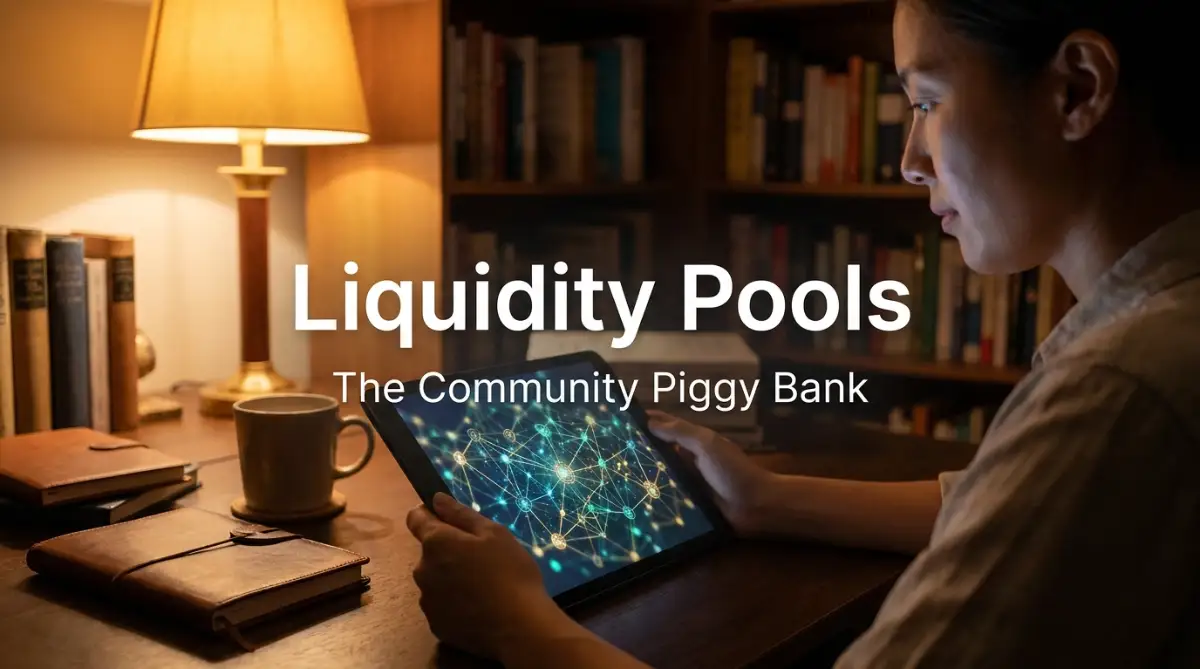
In a decentralized system, there is no central bank holding all the funds in a giant vault. Instead, these platforms rely on everyday users like you and me to provide the money. We do this by putting our digital assets into something called a liquidity pool.
Imagine a massive community piggy bank sitting in the middle of your town square. Anyone in the town can walk up and drop their spare coins into this giant shared jar. When other people in the town want to trade their money, they use the coins available in this exact jar.
Because you helped fill the jar, the system automatically pays you a small fee every time someone makes a trade. You are essentially doing the exact job that a traditional bank used to do. By supplying your assets to the network, you earn the rewards directly, cutting out the greedy middlemen.
This system creates a completely balanced environment where normal people support each other directly. Liquidity pools are the beating heart of these networks, ensuring there is always enough digital money available for trading. Without regular people providing this funding, the entire system would simply stop working.
The Robot Cashier That Never Sleeps
One of the biggest mysteries for new users is how prices are determined without a stock market broker. In a traditional stock market, buyers and sellers have to manually agree on a specific price before a trade happens. If there is no buyer willing to pay your exact price, your trade simply does not go through.
Decentralized networks solve this massive problem by using an Automated Market Maker, or AMM for short. You can picture the AMM as a highly intelligent, mathematical robot cashier that manages the community piggy bank. This robot does not care about finding another human to take the other side of your trade.
Instead, the robot uses a simple math formula to constantly adjust the price based on supply and demand. If a lot of people are buying a specific digital coin from the pool, the robot automatically raises the price. If people are dumping their coins back into the pool, the robot lowers the price to attract new buyers.
This means you can always make a trade instantly, no matter what time of day or night it is. You are never trading directly against another person; you are always trading against the mathematical rules of the pool. This brilliant piece of logic entirely removes the need for order books and traditional financial brokers.
It creates a surprisingly fair market where the math decides the outcome, not a wealthy corporation. Understanding this simple concept takes away the fear of the unknown when you look at these trading platforms.
Earning and Borrowing Without Intermediaries
Another massive part of this digital ecosystem is the ability to lend and borrow money on your own terms. Getting a loan from a traditional bank usually requires mountains of paperwork, credit checks, and weeks of waiting. Even if you have a great credit score, the bank can still deny your application for almost any reason.
Decentralized lending protocols throw this old rulebook completely out the window. They operate entirely on the concept of collateral, much like a traditional pawn shop in your local neighborhood. If you bring a gold watch to a pawn shop, the owner gives you a cash loan based on the watch's value.
They do not ask for your credit score or where you work, because they hold the watch as security. In the digital world, you lock up your digital assets in a smart contract as your collateral. The system immediately allows you to borrow a different digital currency against the value you locked away.
I learned this the hard way when I paid massive fees on a busy network. Always check the network gas fees before you approve a transaction so you do not drain your wallet by accident.
If you fail to pay back the loan, the smart contract simply keeps your locked digital assets to cover the debt. There are no aggressive debt collectors calling your phone and no negative marks on your personal credit report. It is a completely trustless system where the computer code perfectly enforces the rules for both parties.
Myth vs Reality: Clearing the Confusion
When you first start exploring this topic, you will hear a lot of wild rumors from friends and social media. It is very easy to get swept up in the hype or scared away by false information. Let us clear up some of the most common misunderstandings right now.
Many people believe that because there is no bank manager, the system must be completely lawless. In reality, the rules written into the code are actually much stricter than human laws. A computer cannot be bribed, and it will never bend the rules as a favor to a wealthy client.
Understanding the difference between these myths and the facts is your strongest defense against making bad choices. It allows you to approach these tools with a clear head and realistic expectations.
The Hidden Power of Complete Ownership
The most amazing shift that happens when you use these platforms is the sudden realization of complete ownership. When you put your money in a regular bank, that money legally belongs to the bank until you ask for it back. They can freeze your account, limit your withdrawals, or even block you from buying certain things online.
With decentralized protocols, you hold the unique digital keys to your own assets at all times. You interact directly with the smart contracts from your personal digital wallet without giving up custody of your funds. You are effectively acting as your own personal bank, with all the power and responsibility that comes with it.
This level of control is incredibly empowering, but it also means you must be very careful with your security. There is no customer service hotline to call if you accidentally lose your digital keys or send money to the wrong place. You have to take personal responsibility for managing your passwords and protecting your devices from hackers.
We are watching a massive historical shift in how everyday humans interact with value and trust. Instead of trusting massive buildings filled with executives, we are learning to trust open, transparent mathematics.
Watch this simple breakdown to see exactly how these digital agreements work in real time, making the whole process incredibly easy to grasp.
[Insert YouTube Video Link Here]
Navigating the Risks Like a Pro
While the technology is brilliant, I want to be completely honest with you about the risks involved. Just because a smart contract is a clever piece of code does not mean it is perfectly safe from failure. Sometimes human programmers make mistakes when writing the code, creating hidden vulnerabilities.
If a hacker finds one of these tiny loopholes in the code, they can sometimes drain the community piggy bank. This is why you should never put your entire life savings into a single digital platform, no matter how safe it looks. Always start with a very small amount of money that you are comfortable experimenting with.
Take your time to read the instructions, watch educational videos, and understand the specific fees involved in each transaction. Practice moving small amounts of value around until the process feels as normal as sending a text message.
Financial education is not about rushing to get rich overnight; it is about steadily building a deep understanding of new tools. The more you learn about the underlying mechanics, the less intimidating