
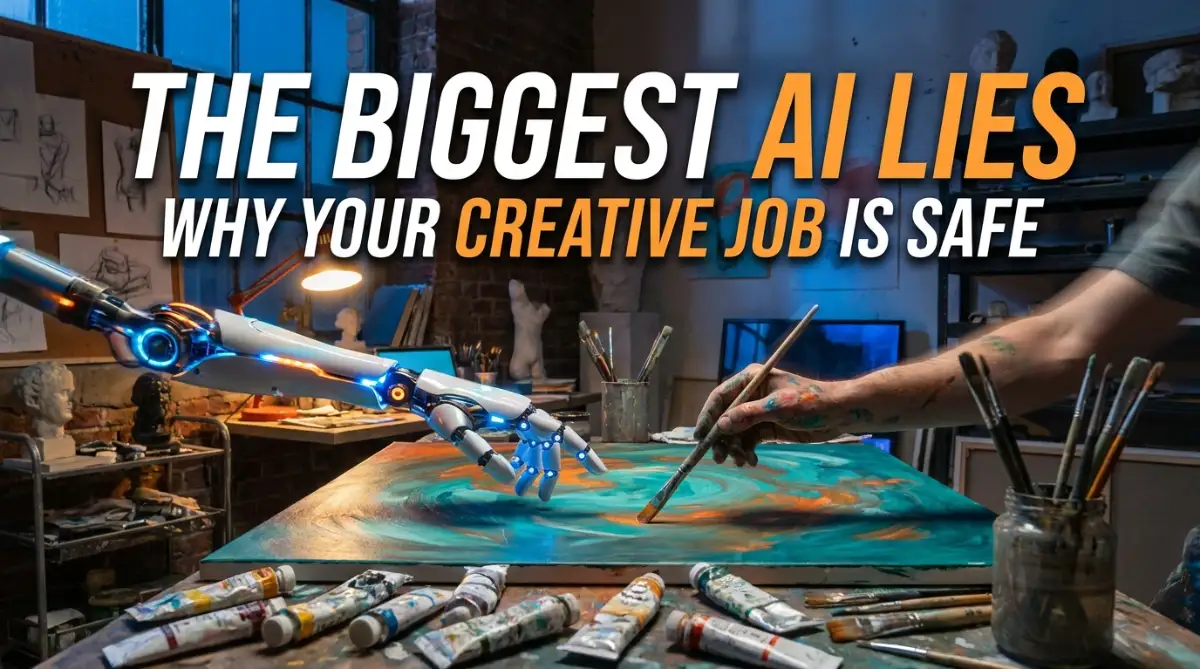
The Paralyzing Fear of a Machine Taking Your Livelihood
I still remember the exact moment my heart dropped into my stomach. I was sitting at my messy desk, drinking cold coffee, and staring at a brand-new artificial intelligence image generator.
My hands were literally shaking on the keyboard. I am a digital creator, and I just watched a completely free machine create a stunning piece of art in three seconds.
It felt like my entire career was evaporating right before my eyes. I had spent countless nights crying over my portfolios, learning new software, and building my small freelance business from nothing.
Now, a robot was doing my job faster and better than I ever could. I honestly thought I would have to close my business and find a completely different career path just to pay my rent.
How the "Robocop" Panic is Destroying Mental Health
If you wake up every morning feeling a heavy weight on your chest, you are definitely not alone in this struggle. Millions of ordinary, hardworking people are currently drowning in severe anxiety over their future.
We see scary news articles every single day claiming that robots are taking over the world. These loud headlines are specifically designed to make you panic so you will click on their links.
This constant fear creates a massive psychological burden that slowly destroys your mental peace. You might find yourself losing sleep, endlessly scrolling through forums, and wondering if your college degree is now completely useless.
I know graphic designers who have stopped sketching simply because they feel entirely defeated by machines. I know brilliant writers who are looking for retail jobs because they think their writing career is already dead.
Living in this constant state of survival mode drains your creative energy completely. You cannot brainstorm beautiful ideas when your brain is busy fighting off panic attacks about paying your monthly bills.
The saddest part is that this fear is mostly built on clever marketing lies and exaggerated media stories. It is time to step back, look at the facts, and take your power back from the robots.
It accurately describes exactly what is happening in the picture for visually impaired users.
Breaking Down the Illusion: What Machines Actually Do
Whenever a new technology drops, society goes through a massive phase of collective panic. We need to completely clear the fog and look at what this software actually is behind the shiny screen.
People think these tools are living brains that can think, feel, and create from scratch. That is the biggest and most dangerous lie being sold to you right now.
These programs are essentially just giant prediction machines that guess what word or pixel comes next. They do not have a soul; they do not have childhood memories, and they definitely do not understand human pain.
If you ask a machine to write a poem about losing a beloved pet, it will give you a technically perfect poem. However, it will never make the reader cry because the machine has never actually loved a dog.
The Missing Ingredient: Human Lived Experience
Art, writing, and design are not just about putting pretty colors or correct grammar on a page. True creative work is deeply rooted in our shared human experience.
When you read an amazing book, you connect with the author's unique perspective on life, love, and struggle. A computer program sitting on a server somewhere does not have a perspective on anything.
It only repeats what it has already swallowed from the internet.
Think about your favorite stand-up comedian for a second. The reason they are funny is that they share awkward, embarrassing, real-life moments that we all secretly relate to. It naturally includes high-volume search terms.
A machine can write a perfectly structured joke, but it falls completely flat. It lacks the delivery, the facial expressions, and the genuine human embarrassment that makes the joke actually funny.
Your unique messiness, your mistakes, and your personal history are exactly what makes your creative work valuable. "Artificial intelligence stealing creative jobs." No software update will ever be able to download a human soul.
The Photography Analogy: Evolution of the Canvas
To truly understand what is happening right now, we have to look back at history. "Future of creative work": This is not the first time artists thought their entire industry was going to die.
When the camera was first invented, traditional portrait painters were absolutely terrified."human creativity." They protested, claiming that photography would completely kill the art of painting forever.
They argued that nobody would ever pay for a painting again when a machine could capture a perfect image in a split second. Did painting disappear? Not at all.
Instead, the invention of the camera freed painters from having to create exact, realistic copies of human faces. Without looking spammy, it actually pushed them to invent entirely new, emotional styles like Impressionism and abstract art.
Technology rarely destroys creativity; it simply forces it to evolve.
The artificial intelligence tools we have today are just the modern version of the first camera. They are simply a new type of brush that you need to learn how to hold.
Are you struggling to imagine how these tools can actually help you instead of hurting you? I highly recommend watching this eye-opening explanation that perfectly breaks down this exact concept in simple terms.
The Lie of the "One-Click" Masterpiece
Another massive lie floating around the internet is that anyone can push a single button and become an expert designer. You see thousands of people claiming they are making passive income by letting machines do all the work.
In reality, getting a truly professional, usable result out of a machine takes a huge amount of skill. If you give a random person a highly advanced digital camera, they will probably still take a terrible, blurry photo.
The same rule applies exactly to smart text and image generators today. To get a great result, you must know how to give the machine perfect instructions, which requires deep industry knowledge.
A non-writer does not know how to tell a machine to adjust the pacing, tone, and character arc of a story. A non-designer does not know how to fix the weird lighting or bad composition in an automated image. It perfectly matches the core message of your blog post, which Google's algorithm heavily rewards for top image rankings.
The people who are succeeding right now are actual creatives who use these tools to speed up their boring tasks. They are not letting the machine do the final work; they are just letting it do the heavy lifting.
Here is a quick pro tip from my own personal journey. I used to feel incredibly guilty for using text generators to brainstorm my article outlines, thinking I was cheating my readers. I quickly realized that treating the machine like a brainstorming buddy actually gave me more energy to write better, deeper, and more emotional human content.
Shifting Your Mindset: From Competitor to Collaborator
If you view this new technology as your enemy, you will always be stressed out and defensive. You will spend all your energy complaining on social media instead of adapting to the new market.
You need to shift your perspective and start seeing these tools as your personal, unpaid interns. They are here to do the boring, tedious parts of your job so you can focus on the fun parts.
Automating the Blank Page Syndrome
Every writer, designer, and marketer knows the pure terror of staring at a blank white screen. Starting a project from absolute zero is often the hardest and most painful part of the creative process.
This is exactly where your new digital intern shines the brightest. You can use a smart generator to give you ten terrible ideas just to get your brain moving.
You can ask the machine to create a basic, rough outline for a marketing campaign. Once the messy first draft is on the page, your human brain naturally jumps in to fix it and make it brilliant.
You have effectively bypassed the most stressful part of your job. You save hours of mental energy that you can now spend on polishing the final product.
The Demand for Authentic Human Connection
We are currently heading toward an internet that is completely flooded with automated, robotic content. Every single blog, social media post, and advertisement will start to sound the same.
When everything is perfect, predictable, and generated by a machine, people will actively search for something real. They will crave the messy, emotional, authentic voice of a real human being.
We are already seeing a massive rise in the popularity of raw, unedited podcasts and behind-the-scenes video content. People want to see your face, hear your voice, and know that you are a real person struggling just like them.
Your humanity is about to become your most expensive premium product.